
API has a successful history of pushing for policy changes and helping other organizations build their skills to achieve similar goals. In the last 20 years, API has played a key role in getting 15 important laws and policies created or improved.
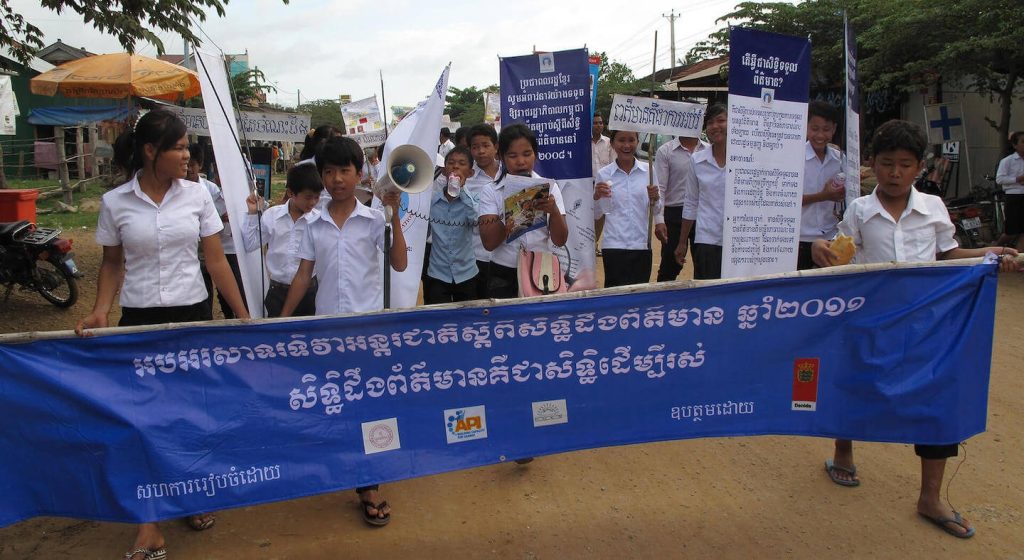
API leads the Access to Information (A2I) Working Group, which includes 18 organizations. The group has played a crucial role in advocating important provisions such as the protection of sensitive personal information and ensuring that the law promotes inclusivity by guaranteeing access for all segments of society, including marginalized groups. Despite these ongoing efforts, Cambodia still does not have a formal Access to Information law as of October 2025.
Efforts to develop such a law have been ongoing for many years. In August 2007, the Government completed a Draft Policy Paper on Freedom of Information. The main opposition party introduced draft Access to Information bills in 2010 and 2012; however, these bills were not approved by Parliament. In 2013, under the leadership of API, the A2I Working Group developed a Model Law that drew on international standards and Cambodia’s specific needs, incorporating input from civil society, government officials, and members of Parliament.
In 2015, the Government established a technical working group tasked with preparing a draft law. API led public consultations before the release of the first government draft. The most recent draft of the law was published in April 2020. While the Government had initially planned to pass the law in 2016, the process was delayed until 2020. In January 2023, Prime Minister Hun Sen stated that the law might be approved after the 2023 elections, potentially in 2024 or 2025.
During the 46th session of the United Nations Universal Periodic Review, the A2I Working Group provided legal advice and recommendations on Access to Information legislation, anti-corruption measures, and digital rights.
There have been four main versions of Access to Information law proposals in Cambodia:
- The policy framework on Access to Information led by the Ministry of National Assembly & Senate Relations.
- The Model Law on Access to Information developed by API and submitted to the Government and Parliament.
- Two draft laws proposed by the Cambodia National Rescue Party.
- Draft laws developed by the Ministry of Information in 2018 and 2020.
API’s leadership has been pivotal in pushing for the clear demands of civil society organizations, focusing on integrating nine internationally recognized principles into Cambodia’s A2I law. These principles are:
- Maximum Disclosure: Presumption that all information held by public bodies is accessible, except under limited, justified exceptions.
- Obligation to Publish: Public bodies must proactively publish key information about their operations, policies, decisions, budgets, and activities without waiting for requests.
- Promotion of Open Government: Governments should actively promote transparency through training, awareness campaigns, and improved information management.
- Limited Scope of Exceptions: Exceptions must be lawfully defined, narrowly drawn, and justified by potential harm to legitimate interests.
- Processes to Facilitate Access: Requests for information should be simple, fast, and inexpensive, with assistance available to requesters.
- Costs: Access should be free or low-cost, covering only reproduction and delivery expenses.
- Open Meetings: Government public meetings should be accessible to the public, with records made available.
- Disclosure Takes Precedence: In cases of doubt, the public interest in disclosure should outweigh secrecy.
- Protection for Whistleblowers: Individuals disclosing wrongdoing should be protected from retaliation.
Please take a look at the link to the UPR and Legal Analysis.
- Joint Submission for the UN Universal Periodic Review for the 46th Session of the UPR Working
- Legal Analysis _Cambodia Draft Law on Access to Information -2020
The Public Procurement Law, enacted in 2023, was partially shaped by API’s recommendations on essential international principles of transparency, fairness, efficiency, and accountability. The Ministry of Economy and Finance adopted four of API’s proposals, including publicizing the procurement process and maintaining transparency at all stages, such as in contracts between buyers and successful bidders.
See the API’s inputs on the Draft Public Procurement Law.
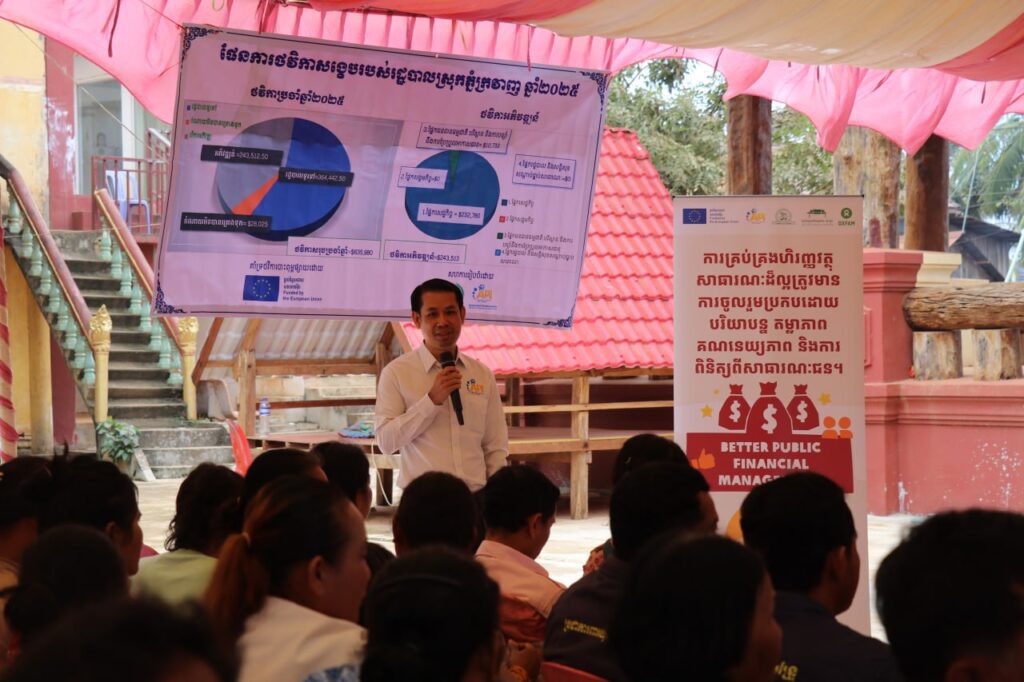
Since 2017, the National Budget Laws have steadily increased funding for education, health, agriculture, and social development. From 2017 to 2024, API led both the Civil Society Organization Budget Working Group and the Coalition for Partnership in Democratic Development, a network of around 100 member organizations focused on promoting democratic governance and accountability. This leadership fostered ongoing, constructive collaboration between civil society, government ministries, and the National Assembly in budget monitoring and enhancing budget transparency.
Furthermore, the Annual National Budget Laws from 2017 to 2025 have raised funding for local governments and broadened budget categories to include social services, social accountability, and environmental protection. API has played a coordinating role in facilitating civil society’s analytical contributions to the budget formulation process.
See CSO’s inputs on National Budget Laws.
- Joint Civil Society Inputs to the Draft Law on Finance and Property Management of Sub-National Administrations
- Summary of Civil Society Budget Working Group Recommendations for the 2026 National Budget
- Key Inputs from the Civil Society Budget Working Group to the PFMRP Technical Working Group
- Joint Analysis and Recommendations from the CSO Budget Working Group on Cambodia’s 2024 National Budget
- Submission of Civil Society Budget Working Group Comments on the Law on Public Financial Management for 2024 Implementation and Future Public Financial Management and Budget Planning Improvements
- Recommendations from the CSO Budget Working Group on the Law on 2024 Finance for Management
- Key Inputs on the New Draft Law on Public Financial Management from the Budget Working Group of National and International Civil Society Organizations-2023
- Summary Results of the National Public Forum on Citizen Participation in Budget Formulation and Public Budget Oversight in the COVID‑19 Context-2022
- Statement on Key Positions and Inputs of the Budget Working Group of National and International Civil Society Organizations on the Development of the Macroeconomic Policy Framework and Public Financial Policy for the Preparation of Draft Laws on Finance for Management 2023
In 2024, API contributed key recommendations to the Draft Social Protection Law and related government initiatives focused on often excluded groups such as people with disabilities, the elderly, and street vendors. API also promoted the Social Protection for All (SP4ALL) initiative and participated in a citizen-led platform that raised public awareness and amplified citizens’ voices to influence government policy frameworks and implementation plans. In 2023, the government progressed by launching the National Social Security Fund (NSSF) package and an economic recovery plan targeting informal workers, including street vendors, domestic workers, and tourism workers. Cambodia continues advancing informal economy development through strategic frameworks like the National Social Protection Policy Framework (2024–2035) and the National Informal Economy Strategy (2023–2028), which include digital registration platforms and emphasize voluntary participation, capacity building, and social protection access.
See CSO’s inputs on draft Social Protection Law and National Social Protection Policy Framework (2024–2035).
API, in collaboration with the Digital Rights Working Group, has been actively advocating digital rights issues, including draft laws and policies related to the National AI Strategy, Personal Data Protection Law, Cyber Crime Law, Cyber Security Law, and the Sub-Decree on Internet Gateway, among others. In 2024, API led the creation of the Phnom Penh Internet Forum, offering a platform for CSOs to contribute input on personal data protection and cybercrime legislation. The government reviewed these contributions during consultations with the Ministry of Post and Telecommunications and incorporated some CSO recommendations, resulting in higher-standard laws that better protect digital rights and personal data. Since 2022, API has led monitoring efforts and produced the Internet Freedom Censorship Report in Cambodia, advocating for internet freedom and digital rights with relevant ministries. Policy dialogues based on these reports and draft law analyses were held with the Ministry of the Interior and the Minister of Post and Telecommunications. The Digital Rights Working Group issued a key message urging the Cambodian Government to ensure that the Draft Law on Information Technology Crimes and the Cyber Security Law comply with international human rights standards and safeguard responsible and safe technology use. Moving forward, API will continue to raise awareness and share updates on new digital rights laws with the public. The Cambodia Internet Censorship Report (2022-2023) and submissions to the Universal Periodic Review (UPR) were shared with development partners, including USAID, EU Member States, the media, the public, and the UN Human Rights Headquarters in Geneva as part of Cambodia’s 2024 UPR process. API remains committed to collaborating with all stakeholders—including the Cambodian government, relevant ministries, and development partners—to provide input on draft laws concerning the right to information, digital rights, and human rights.
See CSOs’ inputs on Digital Rights-related draft Laws and Policies.
- Submission to the Universal Periodic Review of Cambodia – 46th Session of the UPR Working Group-2024
- Factsheet 4th Cycle of The Universal Periodic Review on Cambodia: Freedom of Expression
- Legal Analysis: Cambodia Draft Law on Cybersecurity-2023
- Comments on the Draft Law on Cybercrime ( 6 files)
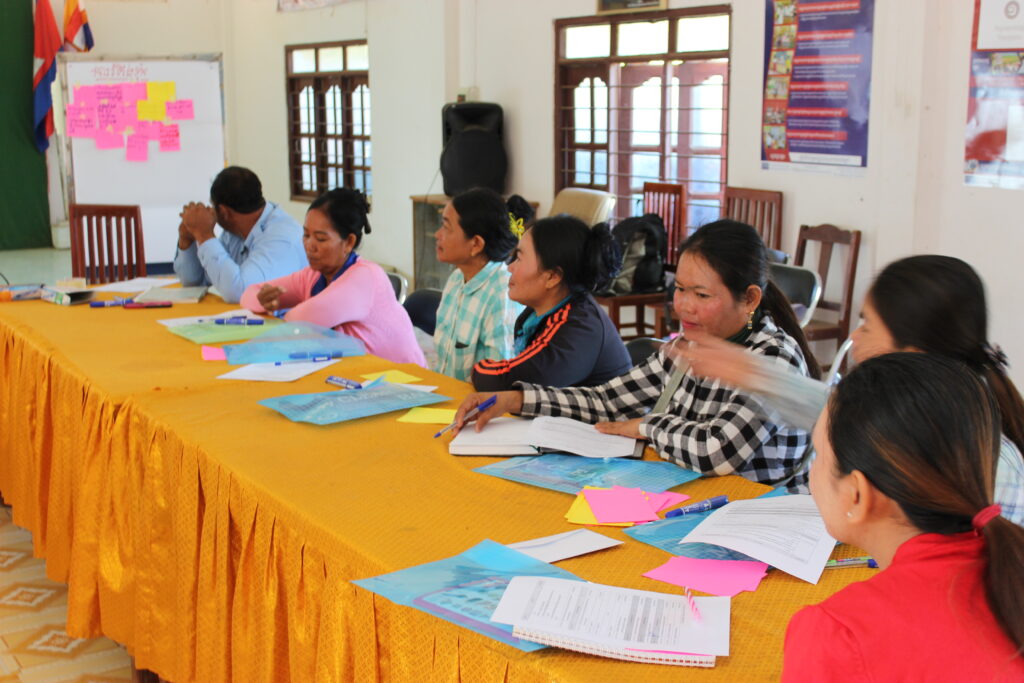
The Social Accountability Framework or ISAF (phases I and II, 2016–2025) has greatly benefited from API’s input in strengthening government policies and guidelines by promoting practices focused on learning, monitoring, and feedback. API supported the framework’s implementation across seven provinces, reaching over 300 communes, 200 health centers, and 700 primary schools. The current phase concentrates on addressing district-level challenges and ensuring the inclusion of disadvantaged groups. API has been an active member of the ISAF Technical Working Group, contributing to the completion of the ISAF Demand Side Operational guidelines for the District/Municipality/Krong (DMK) level in 2025. Additionally, API developed technical guidelines and successfully piloted a Social Protection project within the Social Accountability Framework in 2024.
See CSO’s inputs on Social Accountability Framework.
- Draft guiding technical document for integration of social protection through the implementation of the social accountability strategic plan
- Lessons Learned from “Persons with Disabilities’ Voices and Actions in I-SAF” Project
The New Road Traffic Law 2015 was the outcome of years of collaboration between API and road safety networks, sharing experiences and knowledge to support advocacy efforts. Thanks to this collective work, the law was passed by Parliament in 2015. Continued lobbying led the Ministry of Information to regulate alcohol advertising, launch public campaigns against drinking and driving, and contribute to the development of the draft Alcohol Control Law.
Please take a look at CSO’s inputs on the New Road Traffic Law 2015.
The Anti-Corruption Law 2010: As a member of two working groups, API engaged in discussions on government reports regarding corruption in Cambodia, including those related to the implementation of the United Nations Convention Against Corruption and the Universal Periodic Review. Although the government sought to limit civil society input, API, alongside other CSOs and UN stakeholders, successfully produced a shadow report on several chapters, which was submitted to the UN Human Rights Office in Geneva in late 2018. The Anti-Corruption Law was eventually passed and partially enforced, particularly at the local level, resulting in increased transparency in public service fees and procedures. For more details, see CSO inputs on the UPR Anti-Corruption process.